

Service
Pipe Repair and Replacement in Van Nuys, CA
Some pipes need one fitting. Others have corroded along their whole length and are about to fail again. This page explains how the two are told apart, and what repiping a home involves.
- Spot repairs
- Galvanized to copper or PEX
- Repiping
Pipe Repair and Replacement
When a pipe needs attention
Pipes are out of sight, so they get attention only when they fail. The signs of a pipe that is wearing out are small and gradual: rust-colored or discolored water, pressure that has dropped in one fixture or the whole house, pinhole leaks that appear one after another, crust on fittings, and repairs that keep being needed at new spots along the same line.
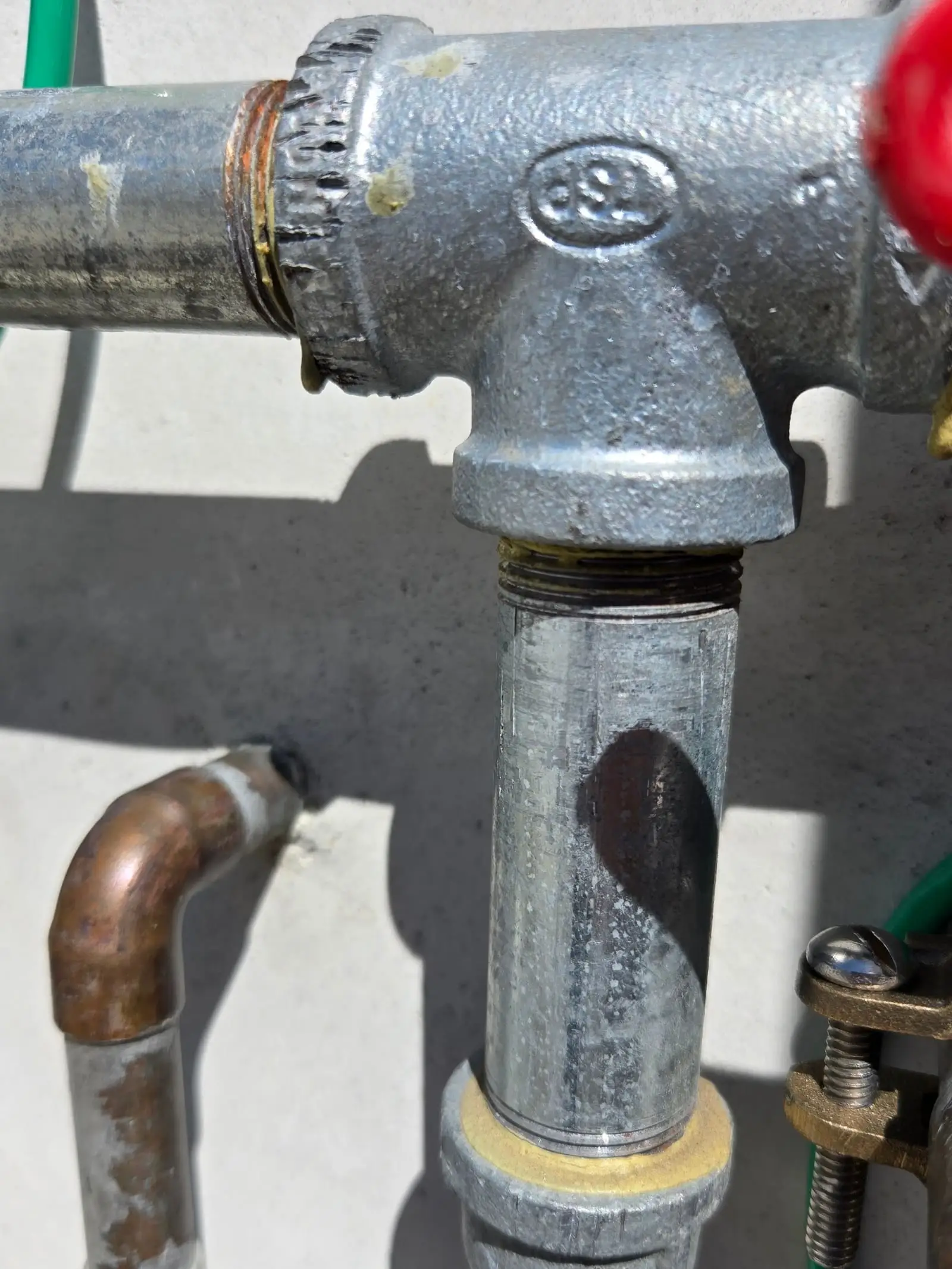
What the pipe is made of matters more than its age. Many homes built before the 1960s have galvanized steel supply lines, which corrode from the inside and slowly narrow until the flow drops. Copper lasts much longer but can develop pinhole leaks. Newer work uses copper or PEX. Drain lines in older homes may be cast iron or clay, and newer ones are ABS or PVC.
- Brown, yellow or rusty water, especially after a faucet has not been used for a while
- Pressure that has been getting worse, in one fixture or the whole house
- Pinhole leaks, or a second leak after the first was repaired
- White or green mineral crust on pipes and fittings
- Visible corrosion, flaking or bulging on exposed pipe
- Banging or knocking in the pipes when water is turned on or off
How the work goes
What the work involves
Repair or replace, decided on evidence
The choice rests on the pipe material, how much of it is corroded, how many leaks it has had and how hard the run is to reach, not on a standard answer.
Materials joined the right way
Joining one metal to another needs fittings made for the transition, because dissimilar metals in direct contact corrode faster. A galvanized to copper change is made with the right union, not by threading one into the other.
Sized and routed for the house
New supply lines are sized for the fixtures they feed and routed to keep openings in walls and ceilings few. The right route depends on how the home is framed and where there is access.
Tested before it is closed
A new or repaired line should be pressure tested before the walls are patched, so that any leak shows while the pipe is still open to see.
Repair or replace?
A single failed joint on a pipe that is otherwise sound is a repair. A pipe that has failed twice in a year in different places, or whose inside has narrowed with corrosion, is usually saying that the whole run is at the end of its life. Replacing only the part that failed can lead to the next failure a few feet along, and each repair opens a wall again.
Replacement does not always mean the whole house: a bathroom or a single run can be replaced on its own.
- Usually a repair: one leak on an otherwise sound line, a failed fitting or valve, damage from a nail or a drill bit
- Usually a replacement: repeated pinhole leaks along one line, galvanized supply pipe with falling pressure or rusty water, pipe that is flaking or brittle when exposed
Galvanized steel to copper or PEX
Galvanized steel was a common supply material until the middle of the twentieth century, and plenty of Valley houses still have some of it, often joined to newer copper where an earlier repair was made. Replacing it means new lines to the fixtures, typically in copper or PEX. PEX is flexible plastic, which can mean fewer joints and less opening in the walls where local rules allow it.
Both are in regular use in California. Which suits a house depends on its framing, its water and the local code.
What repiping involves
A whole-house repipe replaces the supply lines from the main to each fixture. Access is the main variable. In a slab house the new lines can be run through the attic and walls so the slab is left alone, and openings are made in the drywall at a limited number of points and patched afterward. The drain lines are a separate system and are not touched unless they are the problem.
A repipe usually needs a permit and an inspection from the local building department, and the pressure test is part of that. Ask what applies in your city.
Questions
Pipe Repair and Replacement questions
How do I know whether my home has galvanized pipes?
Look at exposed pipe near the water heater or under a sink. Galvanized steel is a dull gray, threaded at its joints and attracts a magnet. Copper is reddish brown and does not attract one, and PEX is flexible plastic, usually red, blue or white. If the pipes are hidden, the age of the house and the type of valves are clues.
Is a pinhole leak in a copper pipe a repair or a replacement?
One pinhole in an otherwise healthy pipe can be repaired by cutting out that section. Several pinholes along the same line suggest the pipe is thinning from the inside, and replacing the run is then usually more sensible than chasing each one.
Does repiping mean tearing up the whole house?
Not normally. Walls are opened at a limited number of points, depending on how the house is framed, and the new pipe is run through the cavities between. Slab houses can often be repiped through the attic without touching the floors. How much opening is needed depends on the home, and it should be explained before work starts.
Will new pipes change my water pressure?
Often, yes, if the old pipes had narrowed with corrosion: new full-size lines let more water through. Pressure also depends on what the utility supplies and on any pressure regulator the house has.
Can a pipe be repaired with the water on?
No. The section has to be isolated and drained first, which is why knowing where your main valve is, and that it still turns, matters for any repair.
More services
Other plumbing services
Corroded pipes or a repeat leak? Talk to a plumber.
Call us or send the form with what you are seeing. If water is running, shut off the main valve first.
Get in touch
Request a plumber
Tell us what is going on and we will call you back.