

How to Size a Water Heater for Your Van Nuys Home: A Practical Guide
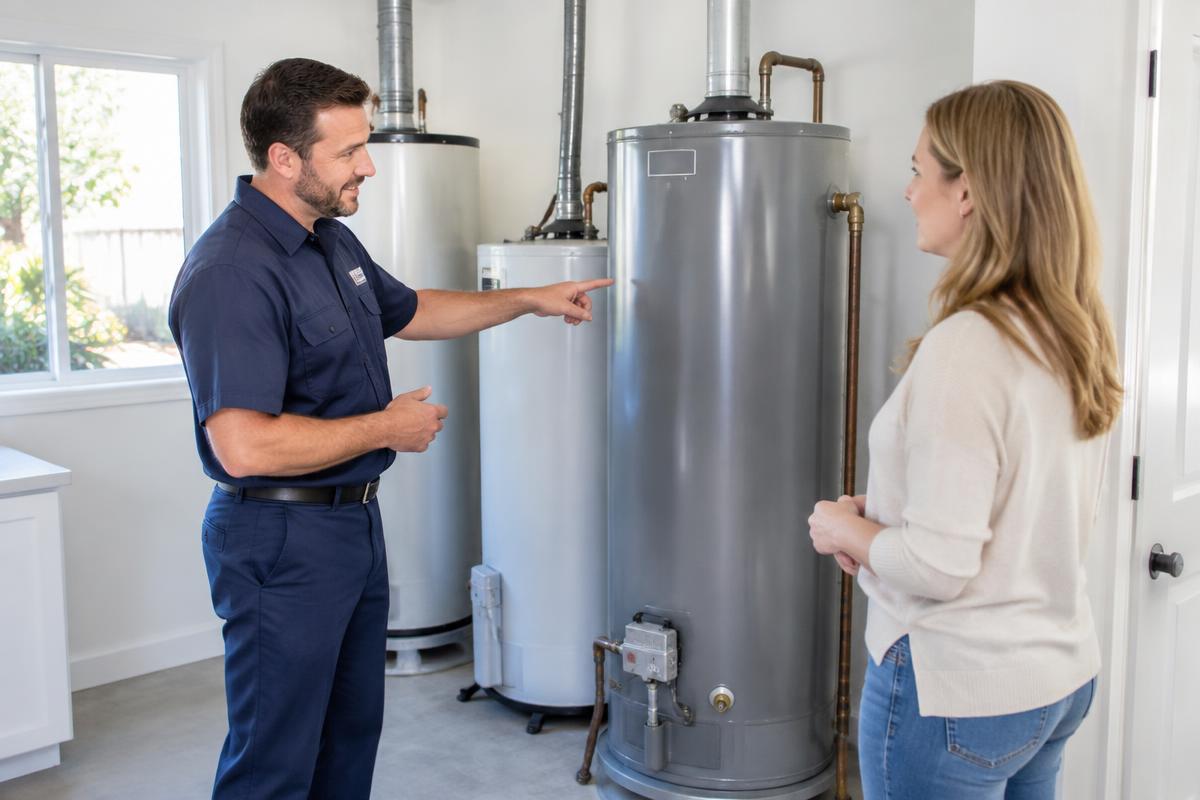
Most homeowners only think about water heater size when the hot water runs out mid-shower, or when an oversized unit quietly pushes up the energy bill. Sizing is not guesswork. It depends on how many people live in the home, when they use hot water, and what the local water does to the equipment over time. Here is how tank and tankless systems should be sized for a home in Van Nuys or anywhere in the San Fernando Valley.
Sizing a Tank: First-Hour Rating, Not Just Gallons
The number that matters for a tank is not storage capacity alone. It is the first-hour rating (FHR): how many gallons of hot water the unit can deliver in one hour of heavy use, counting the stored hot water plus what the heater recovers during that hour.
A practical way to estimate your household's peak-hour demand:
- Shower: about 20 gallons per person
- Bath: about 25 gallons
- Dishwasher load: about 6 gallons
- Laundry load: about 7 gallons
- Kitchen use: about 4 gallons
Add up what happens in your busiest hour. A family of four with overlapping evening showers and a dishwasher load typically needs an FHR in the 55 to 65 gallon range. Pick a tank whose FHR meets or slightly exceeds that figure, instead of just matching the gallon number on the old unit.
Sizing a Tankless System: Flow Rate and Temperature Rise
Tankless sizing works differently. With no storage, you need two numbers:
- Total flow rate of the fixtures that may run at the same time. Showers use roughly 2.0 to 2.5 gallons per minute each, and kitchen and bathroom faucets about 1 to 1.5
- Temperature rise, meaning how many degrees the unit must add to the incoming water to reach your target. Incoming water is colder in winter than in summer, so size for the colder months when demand and rise are both highest
Add the simultaneous flows, confirm the unit can deliver that total at the required rise, and you have the right size. A home that regularly runs two showers and a dishwasher at once needs a larger unit, or two smaller ones, than a home where use is staggered.
Valley Factors That Change the Math
- Hard water and scale: much of the San Fernando Valley has hard water, and mineral buildup inside any system cuts its effective capacity over time, which is why annual water heater service matters as much as the original sizing
- Household changes: size for your busiest realistic stretch, such as visiting family, a home office, or a converted garage unit, not your average Tuesday
- Space and earthquake constraints: garages and closets in older mid-century homes can limit what fits, and in California the tank has to be braced, so a shorter or lower-profile tank can be the answer
- Gas line capacity: larger tankless units often need a bigger gas line, a detail a plumber should check before any replacement
Signs Your Current Unit Is the Wrong Size
- Hot water runs out before the last person gets a shower
- The tank takes hours to recover after heavy use
- Water turns lukewarm at full demand even with the thermostat set correctly
- Energy bills climb with no change in usage, the signature of an oversized tank keeping many unused gallons hot
Any of these is worth discussing in a professional evaluation before you simply replace like for like and inherit the same problem.
Frequently Asked Questions
Is bigger always better for a tank water heater?
No. An oversized tank wastes energy keeping more water hot than you use, and it takes up space. Size to your realistic peak hour, plus a small margin.
Can one tankless unit cover a whole house?
Often yes, but it depends on how many fixtures run at once. Two bathrooms in use with a dishwasher running may call for a higher-capacity unit or a second unit.
Should I size up because Valley water is hard?
Sizing up does not fix scale. Regular maintenance, including flushing, descaling, and anode checks, preserves capacity far better than extra gallons.